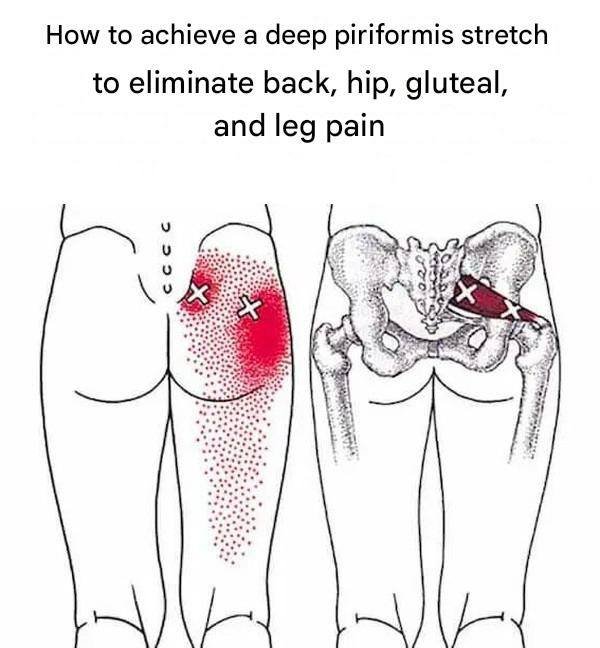
Here’s a thorough guide on achieving a deep piriformis stretch to help relieve tension in the back, hips, glutes, and legs. The piriformis muscle, located deep in the buttock, can compress the sciatic nerve when tight, leading to pain. Stretching it properly can reduce discomfort, improve mobility, and prevent future flare-ups.
Precautions Before Stretching
-
Stretch slowly and gently—never force a position.
-
Avoid stretches that cause sharp pain or tingling down the leg. Mild discomfort is okay.
-
Consult a doctor or physical therapist if you have severe sciatica, herniated discs, or recent injuries.
Deep Piriformis Stretch Techniques
1. Seated Figure-Four Stretch
Target: Glutes, piriformis, outer hip
Steps:
-
Sit on a sturdy chair with feet flat.
-
Cross the right ankle over the left knee, forming a “figure four.”
-
Keep your back straight and hinge slightly forward at the hips until you feel a deep stretch in the right glute.
-
Hold for 30–60 seconds, then switch sides.
-
Repeat 2–3 times per side.
Tip: To increase depth, gently press the crossed knee downward toward the floor.
2. Supine Figure-Four (Reclined Piriformis Stretch)
Target: Piriformis and deep glute muscles
Steps:
-
Lie on your back with knees bent and feet flat on the floor.
-
Cross the right ankle over the left thigh.
-
Reach your hands around the left thigh and gently pull it toward your chest.
-
Keep shoulders relaxed and hips on the floor.
-
Hold for 30–60 seconds, then switch sides.
Tip: Exhale as you deepen the stretch. Relax the jaw, neck, and shoulders for maximal release.
3. Pigeon Pose (Yoga-Based)
Target: Deep glutes, piriformis, hips
Steps:
-
Begin in a plank position. Bring your right knee forward and place it behind your right wrist, with the right ankle near your left hip.
-
Extend the left leg straight back, keeping hips square to the floor.
-
Lower your torso forward over your right leg for a deeper stretch.
-
Hold 30–60 seconds, breathing deeply, then switch sides.
Tip: Place a folded towel or yoga block under the hip of the bent leg if your hip doesn’t reach the floor.
4. Supine Knee-to-Opposite-Shoulder Stretch
Target: Piriformis and glutes
Steps:
-
Lie on your back with knees bent.
-
Lift the right leg and gently pull it across your body toward your left shoulder.
-
Keep the left leg bent or straight on the floor.
-
Hold for 30 seconds, feeling the stretch in the right glute and outer hip.
-
Switch sides.
Tip: Keep movements slow and controlled to avoid lumbar strain.
5. Foam Roller Release (Optional Deep Tissue Aid)
Target: Piriformis and gluteal fascia
Steps:
-
Sit on a foam roller and cross your right ankle over your left knee.
-
Shift your weight onto the right glute.
-
Slowly roll back and forth to massage tight tissue.
-
Spend 1–2 minutes on each side.
Tip: Stop on tender spots and hold pressure for 20–30 seconds for a deeper release.
Additional Tips for Lasting Relief
-
Warm up with a 5–10 minute walk or light activity to increase blood flow.
-
Stretch consistently: Daily or every other day for chronic tightness.
-
Combine with core and glute strengthening: Strong hips reduce piriformis strain.
-
Check posture: Sitting for long periods can aggravate piriformis tension. Take breaks to stand and stretch.
If you want, I can make a 5-minute daily routine combining these stretches specifically to relieve back, hip, glute, and leg pain—perfect for home practice. It would guide you step by step. Do you want me to make that?